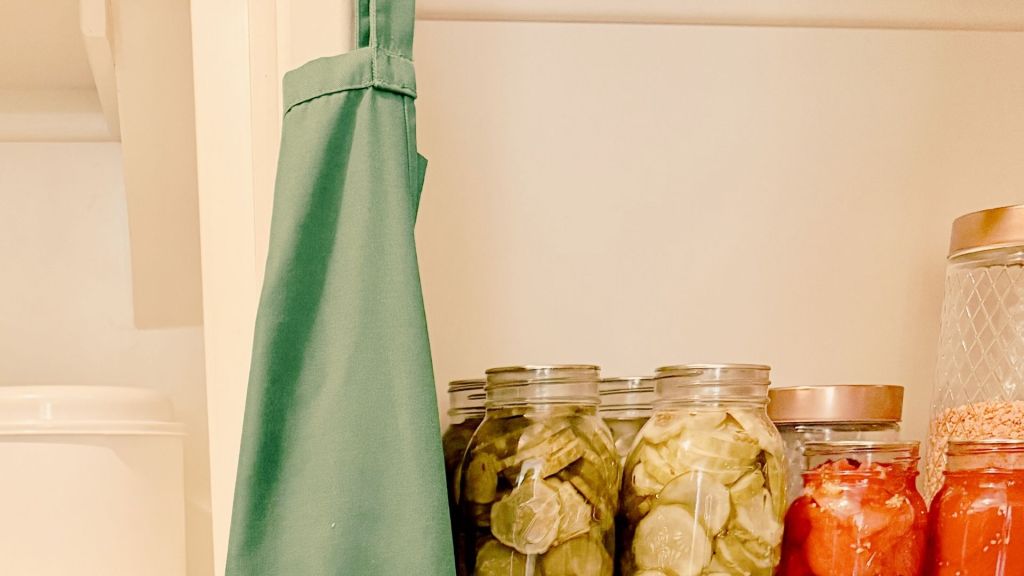
“Tradwife” videos rack up millions of views, and the backlash is just as loud. How women choose to spend their time is as hotly debated today as it was in the 60s.
To many, the word “homemaker” conjures a woman trapped in the past — ironing in pearls, pining for a history that never really existed. For years, I agreed. To be successful, you need to build a career. Building a home would happen later.
The core of the debate centers on what people choose (or don’t choose) to value. But for me, there’s something most arguments ignore. Everyone, whether working or not, could use a better education on homemaking.
While we’ve been volleying ideas about gender roles, we’ve lost a set of skills that once made families more independent from corporations and third parties. Cooking, mending, tending, teaching, stretching every dollar — these weren’t just chores, they were financial strategies.
Now, without them, we outsource everything, from the clothes on our back to the food in our bellies to the training of our children.
And outsourcing, I’ve learned, doesn’t come cheap.
Want more ideas? Get my free weekly email with one outdoor place, kid-friendly outings, and simple dinner ideas for Springfield families.
Walking away from work, and into a different economy
Three years ago, I walked away from a career I had spent a decade building — one that gave me not just a paycheck but pride, purpose and stability. It was a terrifying choice, made not with logic but with a hunger I couldn’t quite satisfy. Emily Oster, in her popular book “Cribsheet,” promised working parents like me that quality time spent with our kids mattered more than quantity. Yet I found myself yearning for ownership over care tasks. I wanted quantity — for the everyday labor of it — not just the special moments before bedtime.
I knew I was giving up income, professional momentum, and future retirement contributions. What I didn’t yet realize was how much I was gaining in return. And in a departure from the usual narrative — the one that dwells on family bonds and emotional rewards — I want to talk about something far less sentimental: the economics.
There’s been much commentary devoted to the dangers of women wasting valuable years at home instead of acquiring income-earning skills. What if she becomes a single mother and needs a paycheck, but has no valuable experience? That’s scary!
I don’t deny this is a precarious position women find themselves in — in fact, my mother was one of them, and I watched as she grappled to learn (and earn) fast. I do not advocate for women not learning workforce skills. But you know what no one has ever told me? Not having homemaking skills also comes at a very real monetary cost.
Home economics isn’t just about sewing aprons. It’s literally economics — the management of money, energy, and resources inside a household. A micro-economy. And mine, I realized, had been on the brink of collapse.
The overlooked math of modern work
Millennials like me were raised by children of the Women’s Rights Movement, and then corporately trained in the “girlboss” era. Growing up, I envisioned myself a careerwoman. Home economics? No need for that.
Schools seem to agree. Family and consumer science classes have mostly faded away, while professional skills are prioritized above all else.
I was well-trained for the workplace — degrees, promotions, negotiation skills. But none of that prepared me for the economics of everyday life. While my earning potential climbed, I never learned a possibly more important skill: proper stewardship of my income. I’m not talking about investments. I’m talking about my home and the contents in it: the food decaying in my fridge, the buttonless coat tossed in a donation bin, and the hundreds and hundreds of dollars I blew each month at grocery stores and restaurants because I was too busy to mind my kitchen.
As my husband and I climbed ladders, we spent as much money as we made just trying to survive a busy lifestyle.
My shocking revelation: careers don’t just earn you money. They cost you money as well.
When I was working full-time, I thought of my salary as money added to the household — but I rarely subtracted the expenses that came with it. Child care alone can swallow a huge chunk of a second income. The average cost in the U.S. ran between $5,400 and $17,000 a year per child in 2022. In some cities, it can rival a mortgage payment.
Then there’s everything else: the second car, the gas, the work wardrobe, the lunches and coffees, the “convenience fees” of working life — takeout dinners, grocery delivery, the house cleaner you finally cave and hire because you can’t keep up.
When you add it all, the extra income from a second job can shrink surprisingly fast, especially if your home economy is overlooked.
Homemaking as economic strategy
When I first stepped out of the workforce, I felt like I had lost all measurable value by society’s standards. No paycheck, no retirement contributions, no line on a résumé. But as I began learning the skills my grandparents took for granted — cooking from scratch, shopping strategically, keeping a budget, mending clothes, making household products instead of buying them — I started to see my time differently.
Instead of generating income for a company, I was generating savings for my family.
One of the most striking changes for me was groceries. When I worked full-time, I did all my shopping at one store closest to my house. Convenience cost me dearly. After becoming a stay-at-home mom, I stretched our grocery budget much further by shopping around, learning which spots had the lowest price per unit and visiting many stores in one week. That small shift in habit — taking the time to plan and shop across stores — cut our grocery bill by almost 60 percent.
Where do I shop in Springfield? Tap to expand list
- Costco and/or Sam’s Club for bulk meat, cheese, yogurt, rice, flour, frozen fruit and high-volume seasonings (salt, garlic powder, pepper), condiments, high-volume canned goods (diced tomatoes, canned beans, tomato sauce, etc.)
- Aldi for weekly small-quantity produce, low-volume spices, low-volume canned goods, corn tortillas, odds and ends
- Asian markets for lentils, dried beans, spices, and certain cuts of meat
- Walmart if I have to one-stop shop
At home, I began implementing pantry stocking and freezing strategies. I buy in bulk, but I also buy seasonally, when foods are at their cheapest, and process them for later in the year when prices spike. In the summer, I’ll freeze peaches for pennies on the dollar and pull them out in December instead of paying triple. A well-stocked pantry and freezer lets me “shop my storage” before I ever write a grocery list, and it dramatically lowers the price I pay per meal.
Thoughtful purchasing is one of the primary skills of an experienced homemaker. We learn to think in seasons, not in weekends. Back-to-school supplies in August cost a premium, but in September they’re practically free. Holiday decorations in December are splurges; in January, they’re half off. Over time, you start to see the retail calendar for what it is: a system you can either be exploited by or learn to game. And you learn to value durability over disposability — buying the pair of boots that will last five winters instead of the cheap ones that fall apart by spring.
We also relearn how to make things ourselves. Simple household products — pillow covers, curtains, cleaning sprays, even basic bread — can be made at home for a fraction of the cost.
More important than all of these, we learn the discipline of maintenance — extending the life of what we already own. A leather bag isn’t disposable if you know how to condition and polish it. A shirt with a loose seam isn’t trash if you can sew it back together. Even linens, if laundered carefully, can last decades instead of seasons. It’s not glamorous work, but it’s the kind of slow, steady stewardship that keeps hundreds of dollars in a household budget year after year.
Economists have tried to put a price tag on this kind of work. Salary.com has calculated that if a stay-at-home mom were paid at market rates for her mix of roles — cook, cleaner, chauffeur, tutor, household manager — her “salary” would top $180,000 a year. Some criticize that number, calling it inflated. But even if it were half of the estimate, it would raise eyebrows.
Time is valuable, even if no one writes us a check for it. Like any new skill, homemaking is only hard and time-consuming in the beginning. Soon, it becomes second nature. And like any good investment, it pays dividends in the years to come. One day I will work a normal job again, and I will have not lost the knowledge and skills I learned at home. My work now will help preserve our independence — protecting our family from the constant pull of consumer culture and the fragile ups and downs of a paycheck.
Should all households run on one income?
I’m not arguing that every household can — or should — run on a single income. Rather, that homemaking has been erased as a serious option, caricatured as cosplay, when in reality it’s an economic strategy.
Homemaking isn’t nostalgia. It’s independence. It’s economy. And reclaiming it may be the most radical, pragmatic move a modern family can make.









 DEAR SPRINGFIELD MAMA
Leave a comment